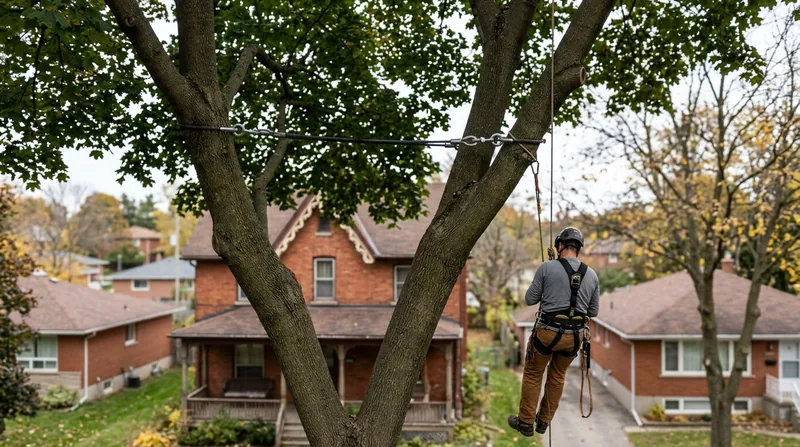




Mature trees across Kitchener often develop structural weaknesses as they age. A cracked scaffold limb, a weak union where two branches meet, or a split crotch can threaten the entire tree and the property below it. Tree cabling and bracing uses flexible cables and rigid braces to support these compromised limbs, allowing your heritage specimen to remain standing rather than removed. Grand Valley Arborists has installed cabling systems on sugar maples, red oaks, and birches throughout the Kitchener area since 2012, preserving mature trees that would otherwise be lost to the chipper. This approach is cost-effective, non-invasive, and backed by ISA Certified Arborists who assess each tree's structural integrity before recommending intervention. Learn more about tree risk assessment to understand whether your tree is a candidate.
Why Tree Cabling Matters When a Limb is at Risk
A tree with a structural defect does not fail overnight, but the risk compounds with ice storms, windstorms, and heavy snow loads common in in Kitchener and the surrounding area winters. Without support, a weak limb may drop onto a roof, a car, or a person. Removal is the safest option when the tree is already declining or when the defect affects the main trunk. However, a healthy, mature tree with a single compromised limb is worth saving. Cabling and bracing transfer the load from the weak union to the healthy wood, extending the tree's lifespan by decades. This is especially valuable in Kitchener's post-war neighbourhoods, where 60- and 80-year-old maples and oaks anchor the streetscape.
- Assess the defect with a certified arborist to confirm the tree is otherwise healthy and worth preserving.
- Install flexible cabling above the weak union to distribute stress across multiple anchor points.
- Add rigid bracing below the defect if the limb is heavy or the union is severely cracked.
- Monitor the system annually and adjust or replace cables as the tree grows or weather takes its toll.
- Avoid removal costs and the loss of mature canopy that took 50 or 60 years to establish.
Cabling is not a permanent cure, but it is a proven way to buy time and keep a valuable tree in your landscape.
Local example: A 65-year-old sugar maple in Bridgeport developed a major crack in its main crotch after an ice storm. Rather than remove it, cabling allowed the tree to remain. Annual inspections cost $150 to $250 per visit, far less than the $800 to $2,000 removal and stump grinding would have cost, and the tree still shades the house 12 years later.
How We Install Cabling and Bracing in the Kitchener Area
Our process begins with a detailed inspection on site. We climb or use a lift to examine the defect closely, measure the limb diameter and angle, and identify the best anchor points in healthy wood. We then select the appropriate cable system (dynamic or static) and determine whether bracing will add strength. Installation takes a few hours for most residential trees, and we clean up all debris before leaving. The system is designed to work quietly in the background, supporting the limb without restricting growth.
- Perform a climbing inspection to locate the defect and assess the overall tree health.
- Select high-strength arborist-grade cable rated for the limb weight and span.
- Install cable anchors in sound wood at least 2 metres above the defect and on opposing sides of the tree.
- Tension the cable to support the limb without over-stressing the tree or restricting sway.
- Add rigid bracing if the crack is deep or the limb is extremely heavy.
- Provide a written inspection report and maintenance schedule for future years.
Real scenario: A red oak on a ravine lot in Wellesley had a major split in its secondary limb, 12 metres high. Two cable systems were installed at different heights to distribute the load. Total cost was $650. Without intervention, the limb would have failed within two to three years, potentially damaging the house below and forcing removal of the entire tree.
Cabling Methods and Materials
| Method | Description | Best For |
|---|---|---|
| Dynamic cable system | Flexible steel cable with elasticity, installed high in the canopy to allow natural sway. | Young to mature trees with moderate defects; allows movement in wind. |
| Static cable system | Rigid or semi-rigid cable closer to the defect, providing immediate support with minimal flex. | Older trees with severe cracks or heavy limbs where motion must be restricted. |
| Rigid bracing | Metal rods installed through or across the defect to lock the limb in place. | Deep cracks, severely split crotches, or limbs that cannot tolerate any movement. |
| Combined approach | Cable and brace used together for maximum support and long-term stability. | Large heritage trees with multiple weak points or extreme structural compromise. |
All materials are installed by ISA Certified Arborists following industry standards. Cable and hardware are inspected annually and replaced when wear becomes visible, typically every 7 to 10 years depending on the tree's growth rate and local weather.
Regulations and Safety Around Kitchener Hydro Lines
If your tree stands near the private service entrance where power lines connect to your house, we maintain safe approach distances and never work on the public distribution network operated by your local utility or Hydro One. Cabling work is performed on your private tree and does not involve any utility infrastructure. If a limb is actually touching or very close to the public lines, that situation must be referred to your local utility for clearance or removal. Otherwise, cabling is a straightforward private tree service with no permitting requirements in most cases.
See our utility line clearance service if you are unsure whether your tree conflicts with the public network.
When to Cable Your Tree
Cabling can be installed at any time of year, but we recommend scheduling the initial assessment and installation in late fall or early winter, when the tree is dormant and the defect is easiest to see. If the limb is actively cracking or appears to be failing, contact us immediately for an emergency evaluation. Annual inspections should occur in late fall before heavy snow loads arrive. Request a tree risk assessment to determine if your tree is a candidate and to establish a maintenance plan.
Our crews respond to emergency calls 24/7 across Kitchener and the surrounding municipalities. If a limb has partially failed or is hanging dangerously, call (548) 490-1230 right away.
Cost and Next Steps
A free estimate begins with a site visit and climbing inspection. We assess the defect, measure the limb, and recommend the best cabling or bracing approach. Most residential trees in Kitchener range from $500 to $1,200 for a single cable system, depending on tree height, limb size, and the number of anchor points required. Rigid bracing or multiple cable systems cost more. Contact us today for a free quote, or call (548) 490-1230 to discuss your tree by phone. We serve Kitchener, Cambridge, Woolwich, Wellesley, North Dumfries, and the Region of Waterloo.
Prices Tree Cabling & Bracing in Kitchener — Indicative pricing
| Service | Price | Details |
|---|---|---|
| Single dynamic cable system | From $500 | Flexible cable installed high in canopy for moderate structural defects |
| Static cable or rigid brace | From $650 | More rigid support for severe cracks or heavy limbs |
| Combined cable and brace system | From $900 | Maximum support for heritage trees with multiple weak points |
| Annual inspection and maintenance | From $150 | Check cable tension, inspect for wear, adjust or replace as needed |
| Travel and site assessment | Included | Free estimate in Kitchener and the surrounding area |
| Free quote | No charge | Climbing inspection, written recommendation, and pricing within 24 hours |
Indicative prices; free, personalized estimate within 24h at (548) 490-1230.