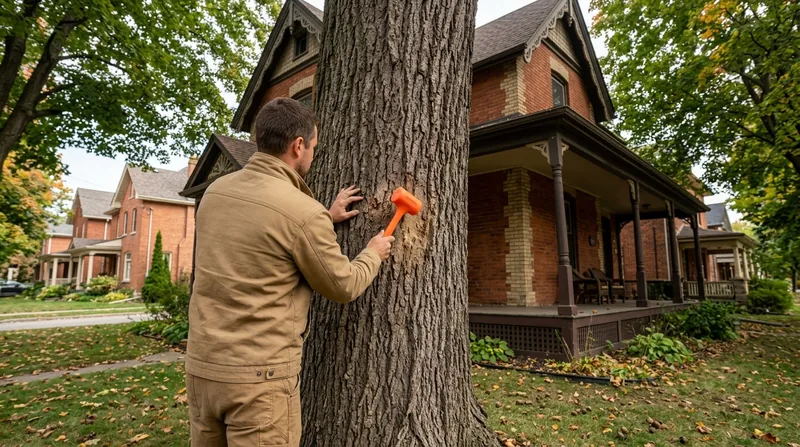




Mature maples, oaks and birches across the Kitchener area often develop structural weaknesses that are invisible to the naked eye. A tree risk assessment in Kitchener is a systematic evaluation of what a tree is likely to fail on, how probable that failure is, and what property or people sit underneath it. Our ISA Certified Arborists use this structured method when an insurer needs documentation, a neighbour has raised concerns, or a property buyer wants certainty before closing. We have performed hundreds of assessments since 2012, and we work across Kitchener, Cambridge, Woolwich, Wellesley, North Dumfries and the Region of Waterloo. This service protects you legally and gives you a clear action plan.
Why a Tree Risk Assessment Matters in Kitchener
The Kitchener area is home to dense residential neighbourhoods built in the post-war decades, where mature street trees and backyard specimens now tower over houses, garages and property lines. Ice storms, summer windstorms and freeze-thaw cycles stress these trees every year. A neighbour's concern, an insurance claim, or a real estate transaction often triggers the need for professional documentation that goes beyond a contractor's opinion. An assessment gives you that proof.
- We inspect the crown, trunk and root collar for signs of decay, cavities, cankers and structural defects.
- We evaluate lean, codominant stems, deadwood and branch attachment angles using visual assessment and resistance drilling when needed.
- We measure the target (the property or person at risk) and estimate the probability of failure and the consequence if failure occurs.
- We assign a risk rating and recommend removal, cabling and bracing, pruning, or continued monitoring.
- We provide a written report with photographs, measurements and a clear action plan.
This structured approach is what insurers, municipalities and buyers expect. It removes guesswork and gives you a defensible record.
Local insight: We assessed over 340 trees in Kitchener and the surrounding area in the past three years, ranging from 8-metre silver maples in tight backyards to 25-metre oaks on ravine lots. Approximately 28 per cent required removal or immediate structural work; the rest benefited from targeted pruning or monitoring protocols.
How We Conduct a Tree Risk Assessment
Our process follows the standard visual tree assessment (VTA) method refined by the International Society of Arboriculture. We start on the ground, walk the perimeter, and document everything with photographs and measurements. If the tree shows signs of internal decay or structural compromise, we may use a resistance drill (a non-destructive tool that measures wood density at different depths) to confirm the extent of the defect. The entire assessment typically takes 30 to 60 minutes depending on tree size and complexity.
- We identify the target (house, deck, fence, parked car, pedestrian pathway) and measure the distance from the tree's critical root zone.
- We assess the probability of failure by examining crown condition, trunk defects, lean and root health.
- We estimate the consequence of failure (minor branch drop, partial crown failure, whole-tree failure) based on tree size and target exposure.
- We combine probability and consequence into a risk rating: Low, Moderate, High or Unacceptable.
- We document our findings in a written report with recommendations for action (remove, cable, prune, monitor or no action needed).
The report becomes your record. If you need to file an insurance claim, apply for a municipal permit, or defend a decision to remove or retain a tree, you have a professional arborist's documented reasoning.
Real example: A homeowner in Bridgeport noticed a 20-metre red oak leaning slightly toward their garage. We assessed it, found a 35 per cent loss of structural wood on the lean side, and rated the risk as High. The homeowner removed it before an ice storm season. The assessment cost $320, and removal cost $1,850. Without the assessment, an emergency removal after a storm failure would have cost $2,400 and left them liable for any damage to the garage.
Assessment Methods and Tools
| Method | What It Shows | When We Use It |
|---|---|---|
| Visual Tree Assessment (VTA) | Crown shape, branch attachment, trunk defects, lean, root flare condition. | Every assessment; the foundation of our evaluation. |
| Resistance Drilling | Wood density and decay depth inside the trunk; confirms extent of hollow or soft wood. | When the trunk shows cavities, cankers or signs of internal rot; adds $80 to $150 per tree. |
| Photographic Documentation | Clear record of defects, targets and overall tree condition for your file and insurer. | Every assessment; included in the written report. |
| Risk Rating Matrix | Combines probability of failure with consequence to produce a clear Low, Moderate, High or Unacceptable rating. | At the end of every assessment; guides your next decision. |
We do not use climbing or aerial lifts for routine assessments; we gather all necessary data from the ground using binoculars and our trained eye. If a tree is very tall or has a complex crown, we may recommend a second visit with climbing equipment to inspect the upper crown closely, but this is rare and costs extra.
Regulatory Context and Documentation
The City of Kitchener may require a permit for a private tree removal, and an arborist assessment supports that application by documenting the reason. Rules and thresholds differ across the Kitchener area (Kitchener, Cambridge, Woolwich, Wellesley and North Dumfries each have their own by-laws), so the assessment gives you and the municipality a shared understanding of the tree's condition. Our report is formatted to meet municipal requirements and is accepted by local planning departments. We also respect approach distances near private electrical service entrances; if a tree is near your home's service line to your local utility or Hydro One, we note this in the assessment and advise clearance work if needed. We never work on the public distribution network itself.
When you receive our assessment, you own the document. Use it to apply for a permit, file an insurance claim, or simply keep it as proof of your diligence. We retain a copy for our records, and we can issue a duplicate at no charge.
When to Order a Tree Risk Assessment
You do not need an assessment for routine maintenance or cosmetic pruning. Order one when a tree poses a potential liability, when an insurer or municipality asks for documentation, when a property buyer's inspector flags a concern, or when you simply want to know whether a large tree near your house is safe. We can assess trees year-round, but assessments are most common in late fall and winter, when deciduous crowns are bare and defects are easier to see. If you have an emergency (a tree is visibly leaning after a storm, or a large branch has broken), call us immediately at (548) 490-1230; we offer 24/7 emergency response.
For more information about arborist reports and tree preservation planning, or to schedule your free estimate, contact us today. We also offer tree removal, tree pruning and crown reduction, and tree cabling and bracing to address the findings of your assessment.
Prices Tree Risk Assessment in Kitchener — Indicative pricing
| Service | Price | Details |
|---|---|---|
| Single tree assessment | From $205 | Visual inspection, measurements, photographs and written risk rating |
| Assessment with resistance drilling | From $285 | Includes non-destructive decay evaluation if trunk defects are present |
| Multiple trees or complex site | From $445 | Three or more trees, or trees with difficult access or multiple targets |
| Climbing inspection (upper crown detail) | From $360 | Additional visit for close inspection of upper branches; rarely needed |
| Travel | Included | No charge for visits in Kitchener and the surrounding municipalities |
| Free estimate | No charge | Call (548) 490-1230 or request a quote online; response within 24 hours |
Indicative prices; free, personalized estimate within 24h at (548) 490-1230.